

Myth 7 - The Classical Music Effect
education exchange
In 2025, 3 papers published research from over 4,500 teachers across 12 counties on the most commonly held myths in education. In this series of blogs, we will be looking at the 10 most common myths, how they came about, and the realities surrounding them.
Can you spot a myth? Try this fun quiz based on some of the questions teachers were asked in the research studies
Spot the myth - Try here
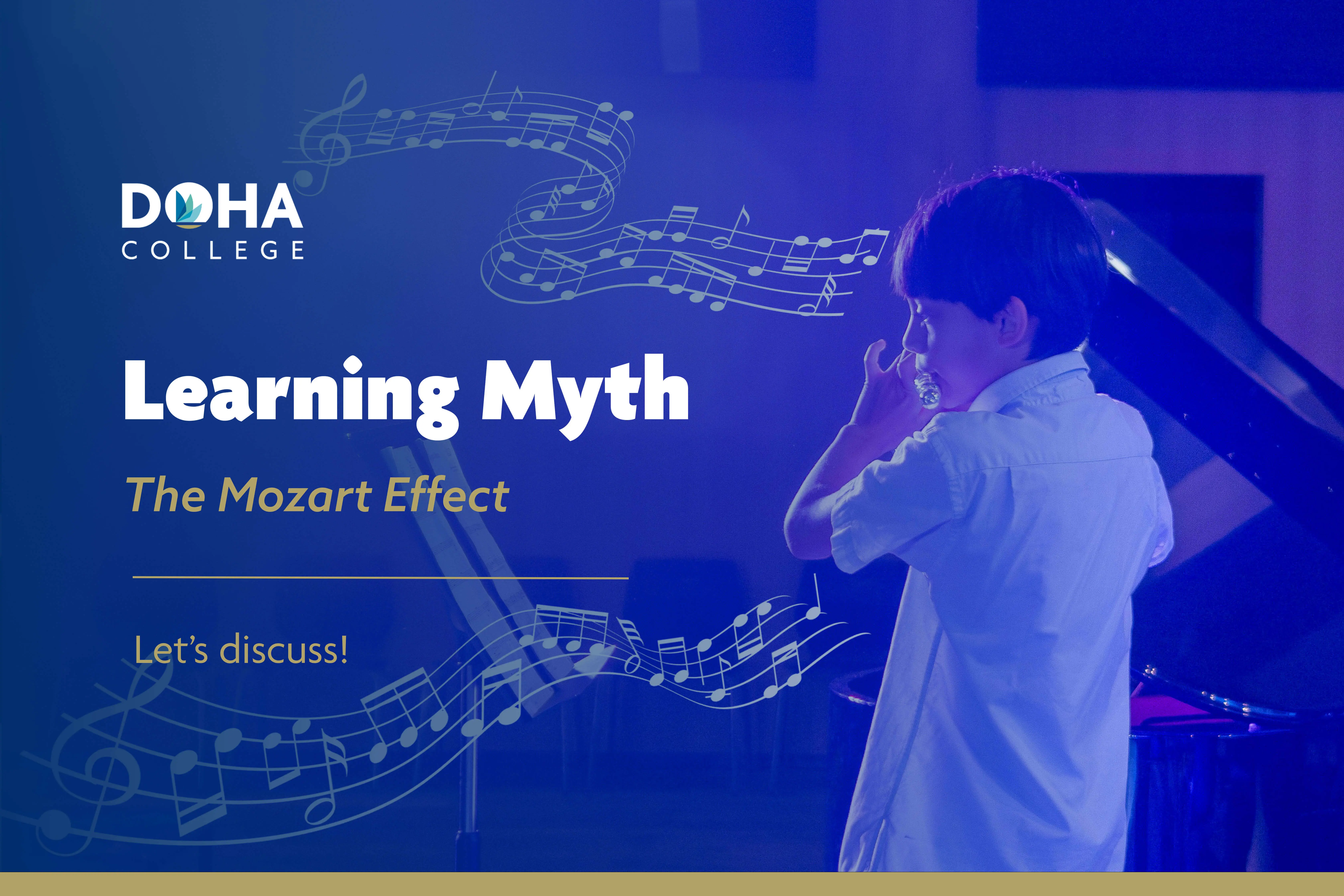
Myth 7 - The Classical Music Effect
I remember in Year 4, my class teacher came bounding in one day, excited about some research that she had read in the paper. She told our class that listening to classical music could help boost our performance. What followed was a lesson listening to classical music as we wrote a poem. We never did it again. I think the teacher just wanted some peace and quiet. What caught my Year 4 teacher’s eye is an idea that has held firm through the decades. It led to Don Campbell trademarking the ‘Mozart Effect’ and publishing books and curated CDs claiming to boost the intelligence of young children and unborn babies.
The Reality
Rauscher et al (1993) completed a study of 36 university students, who listened to 10 minutes of Mozart, then completed a task about folding and cutting paper. A spatial reasoning task, not an intelligence test. They found a small, temporary improvement on that specific task. Not only are the tasks and age groups not relevant to teaching children, but the study failed replication. Even Rauscher himself has said that the idea that classical music makes children smarter is a myth. However, when have facts ever stopped a good media story? Realising the study made great headlines, the media jumped on the “Mozart Makes You Smarter” bandwagon, and the myth was here to stay.
Classroom Impact
Not only does playing music not improve outcomes, but some music can actually make outcomes worse. Our brains automatically process speech for meaning, even when we don’t intend to. Listening to music in a language that our brain understands can overload our working memory, making it harder to encode new information or retrieve what we already know. While playing classical music or (my favourite) white noise will not boost learning, if this is a less distracting sound than the alternatives, it can be beneficial. What would be better, listening to unfamiliar classical music or having to contend with someone around you holding a conversation, or your sister watching TV as you try to study? The recommendation - for tasks requiring high cognitive load (like writing or complex problem-solving), silence is golden. If silence isn't possible, steady-state noise (white/pink noise) is the next best thing.

Sources
- Fernández-Miras, J.G., Aguilar-Parra, J.M., Trigueros, R. and López-Liria, R. (2023) 'Beyond neuromyths: Examining in-service teachers’ misconceptions about teaching and learning', Frontiers in Psychology, 14, p. 1144002. doi: 10.3389/fpsyg.2023.1144002.
- Adiguzel, O.C., Potvin, P., Sarrasin, J.B., Vanhoolandt, C., Corfdir, A., Japashov, N., Mansurova, A., Tsai, C.C., Wu, C.L., Elmas, R., Atik-Kara, D., Kucukkayhan, S., Zaid, A.K., Kouchou, I., Voulgari, A., Sy, O., Sakho, I., Ng, S.B., Charland, P. and Létourneau, A. (2025) 'Belief in neuromyths among primary school teachers: a cross-national study of 11 countries', Trends in Neuroscience and Education, 40, p. 100264. doi: 10.1016/j.tine.2025.100264.
- Tunga, Y., Çelik, B. and Cagiltay, K. (2025) 'Educational myths among teachers: prevalence and refutational intervention for belief change', Humanities and Social Sciences Communications, 12, 1619. doi: 10.1057/s41599-025-05470-y.
- Rauscher, F.H., Shaw, G.L. and Ky, K.N. (1993) ‘Music and spatial task performance’, Nature, 365(6447), p. 611.
- Pietschnig, J., Voracek, M. and Formann, A.K. (2010) ‘Mozart effect–Shmozart effect: A meta-analysis’, Intelligence, 38(3), pp. 314–323.
- Chabris, C.F. (1999) ‘Prelude or solo for "Mozart effect"?’, Nature, 400(6747), pp. 826–827. (This is a famous critique/failure to replicate).
- Perham, N. and Currie, H. (2014) ‘Does listening to preferred music improve reading comprehension performance?’, Applied Cognitive Psychology, 28(2), pp. 279–284. (This supports your claim that liked/familiar music with lyrics can actually hinder performance).
- Sweller, J. (2011) ‘Cognitive load theory’, Psychology of Learning and Motivation, 55, pp. 37–76. (The foundational theory for why "overlapping" sounds overload the brain).