
Myth 10 - The "Discovery Learning" Dream
education exchange
In 2025, 3 papers published research from over 4,500 teachers across 12 counties on the most commonly held myths in education. In this series of blogs, we will be looking at the 10 most common myths, how they came about, and the realities surrounding them.
Can you spot a myth? Try this fun quiz based on some of the questions teachers were asked in the research studies
Spot the myth - Try here
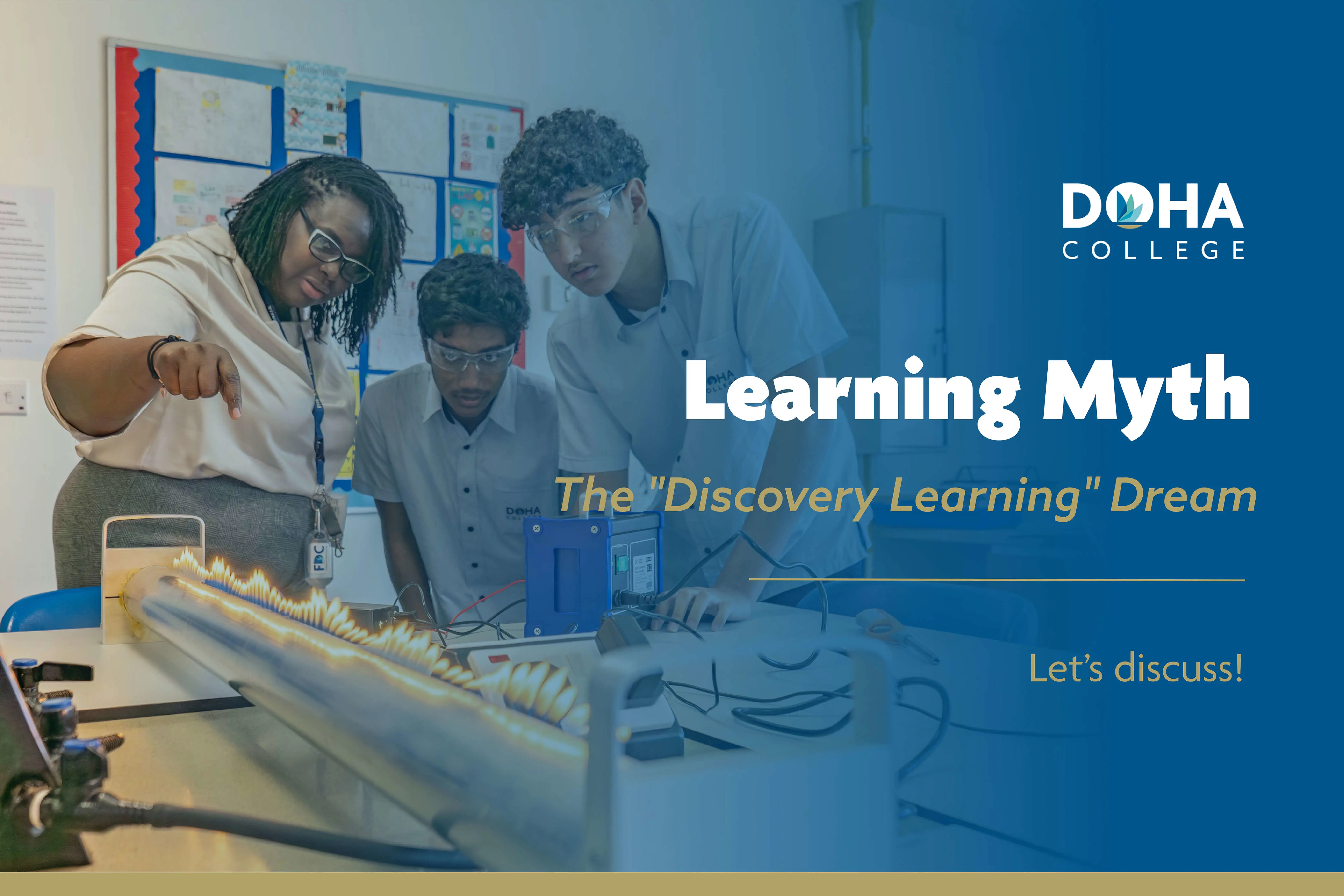
Myth 10 - The "Discovery Learning" Dream
I Who remembers the excitement of a "Project-Based Learning" week? The classroom is buzzing, students are huddled in groups, and the teacher is the "guide on the side," watching as pupils supposedly "discover" the laws of physics or the causes of the Industrial Revolution for themselves.
It’s a beautiful vision. We want our students to be mini-scientists and budding historians, finding their own way to the "Aha!" moment. There’s a widespread belief that if a student struggles to find the answer themselves, they’ll own that knowledge more deeply.
The Reality
The reality is that for a novice learner, being thrown into the deep end without a life jacket doesn't teach them to swim, it just causes them to panic. The reality is... "discovering" information is one of the most cognitively taxing and inefficient ways to learn new material. There are several issues with discovery learning:
Cognitive Overload: Open-ended problems overload working memory before students have the mental "hooks" (schemas) to hang the information on. Rather than devoting resources to solving the problem, they use up much of their working memory trying to understand what is being asked. (Kirschner, Sweller & Clark, 2006).
The Illusion of Learning: Students often report feeling more "engaged" during discovery activities, but tests show they actually retain less. We must be careful not to confuse "busy-ness" with understanding (Deslauriers et al., 2019).
The Expertise Gap: Most evidence supporting Problem-Based Learning (PBL) comes from higher education or expert learners. For our school-age novices, explicit instruction consistently outperforms discovery for speed and retention (Hattie, 2009).
Equity Issues: Minimally guided instruction tends to widen the attainment gap. Students with high prior knowledge might navigate the chaos, but those who start with less are left further behind (OECD, 2018).This particularly impacts those who are already at a disadvantage due to their socioeconomic, family or cultural background.
Caveat - the expertise reversal effect. Research has found that once someone is an expert they do learn better from problem-solving rather than direct instruction (hence why university studies come back more positively on this). The reality is that school pupils are not experts, but also explains why revision through practicing past papers is more beneficial than reteaching (assuming they have hit mastery of the topics).
Classroom Impact
This doesn't mean we never let students solve problems. It means we have to get the timing right. Problem-solving is the goal of education, but it is rarely the best method for initial learning.
To make a real impact, we should lead with Explicit Instruction: Start with clear explanations and worked examples. This secures core knowledge and keeps the cognitive load manageable. Save the open-ended projects and PBL for the end of a unit. Students can only "problem-solve" effectively once they have sufficient prior knowledge to draw upon.
Don’t expect a child to realise that vinegar is more acidic coffee by looking at the shade of litmus paper, they may just assume that vinegar has more ‘red particles’. Instead teach them about acids, the PH scale and litmus paper, then ask them to order liquids by acidity. They are still problem solving, but this time with the knowledge of what to look for and without creating misconceptions.
You are an expert in your subject. Do not let pupils ‘research’ your expertise online. A friend of mine in London was checking their child’s science book, only to discover that their child had written that ‘vaccines may cause autism’. The teacher had set the class the challenge of ‘researching’ the pros and cons of vaccines online.
Sources
- Deslauriers, L., et al. (2019). Measuring actual learning versus feeling of learning in response to being actively engaged in the classroom. PNAS.
- Kirschner, P. A., Sweller, J., & Clark, R. E. (2006). Why Minimal Guidance During Instruction Does Not Work. Educational Psychologist.
- Kirschner, P. A., & Hendrick, C. (2020). How Learning Happens.
- Willingham, D. T. (2007). Why Don't Students Like School?
- Fernández-Miras, J.G., Aguilar-Parra, J.M., Trigueros, R. and López-Liria, R. (2023) 'Beyond neuromyths: Examining in-service teachers’ misconceptions about teaching and learning', Frontiers in Psychology, 14, p. 1144002. doi: 10.3389/fpsyg.2023.1144002.
- Adiguzel, O.C., Potvin, P., Sarrasin, J.B., Vanhoolandt, C., Corfdir, A., Japashov, N., Mansurova, A., Tsai, C.C., Wu, C.L., Elmas, R., Atik-Kara, D., Kucukkayhan, S., Zaid, A.K., Kouchou, I., Voulgari, A., Sy, O., Sakho, I., Ng, S.B., Charland, P. and Létourneau, A. (2025) 'Belief in neuromyths among primary school teachers: a cross-national study of 11 countries', Trends in Neuroscience and Education, 40, p. 100264. doi: 10.1016/j.tine.2025.100264.
- Tunga, Y., Çelik, B. and Cagiltay, K. (2025) 'Educational myths among teachers: prevalence and refutational intervention for belief change', Humanities and Social Sciences Communications, 12, 1619. doi: 10.1057/s41599-025-05470-y.