


Myth 6 - Maslow’s Hierarchy of Needs
education exchange
In 2025, 3 papers published research from over 4,500 teachers across 12 counties on the most commonly held myths in education. In this series of blogs, we will be looking at the 10 most common myths, how they came about, and the realities surrounding them.
Can you spot a myth? Try this fun quiz based on some of the questions teachers were asked in the research studies
Spot the myth - Try here
Myth 6 - Maslow’s Hierarchy of Needs
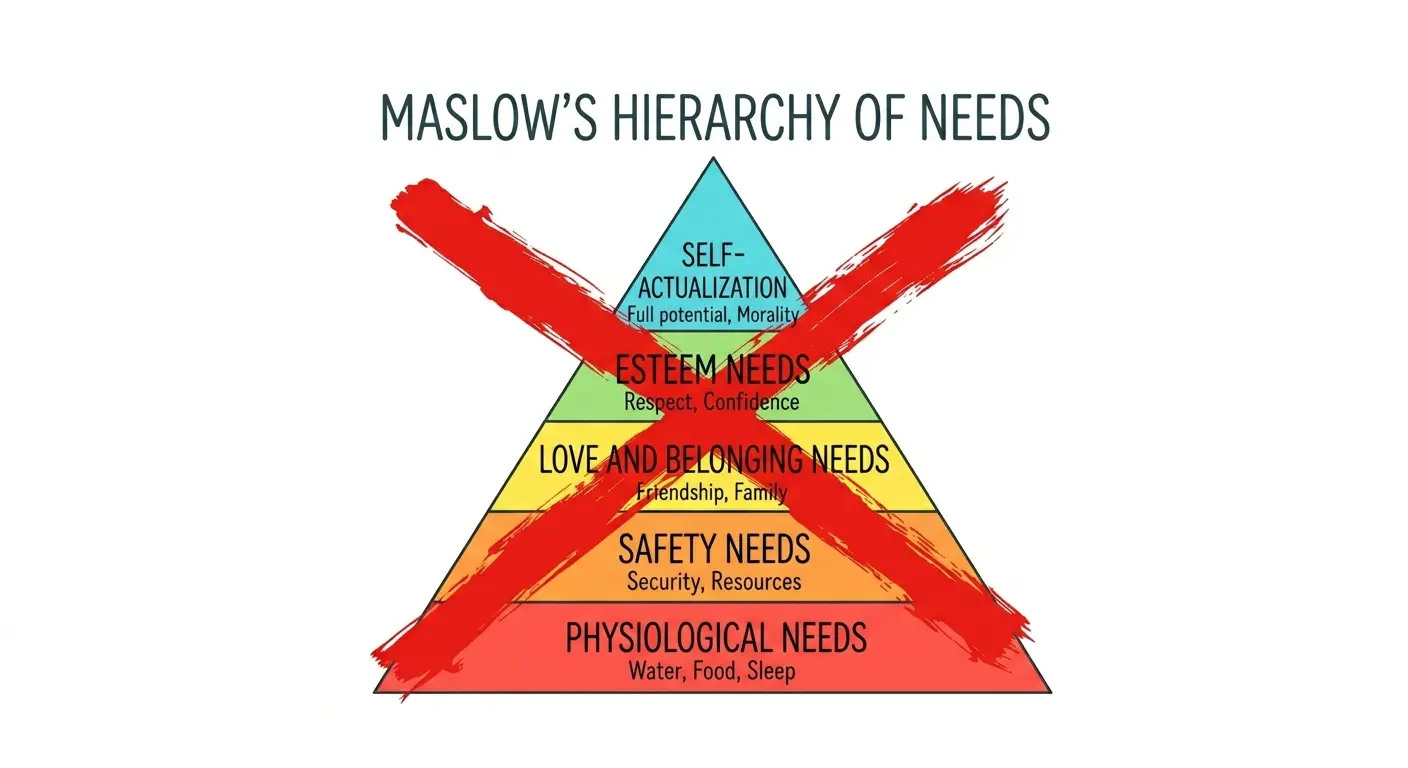
Maslow’s pyramid of needs diagram shows people’s basic needs in order of importance. It suggests that higher levels of needs in the hierarchy emerge once people feel they have sufficiently satisfied the previous need. For example, needs for love and belonging emerge once people have satisfied their physiological needs (water, food, clothes etc).
The Reality
Maslow never actually drew a pyramid. His 1943 did identify 5 human needs: Physiological, Safety, Belonging, Esteem, Self-actualisation - but these were never ranked. The pyramid started to appear in management textbooks in the 1960s.
The pyramid oversimplifies human motivation and does not accurately reflect how needs are prioritised or fulfilled in real life (Compton, 2018; Wahba & Bridwell, 1976). For example, someone who is sick can still feel belonging to a community. A person in a refugee camp may not always have their basic needs met, but still feel part of friendships and family.
Classroom Impact
Pupils do not need to satisfy lower-order needs for learning to occur. Through consistent routines and clear structure, we provide a sense of safety and stability. We build genuine belonging through active participation and inclusion. Yes, physiological needs and safety are essential, but we recognise that a deficit in these areas doesn't preclude a pupil from pursuing higher-order needs like belonging or achievement. We support them emotionally while still maintaining challenge. We don’t drop our expectations because of external factors.

Sources
- Fernández-Miras, J.G., Aguilar-Parra, J.M., Trigueros, R. and López-Liria, R. (2023) 'Beyond neuromyths: Examining in-service teachers’ misconceptions about teaching and learning', Frontiers in Psychology, 14, p. 1144002. doi: 10.3389/fpsyg.2023.1144002.
- Adiguzel, O.C., Potvin, P., Sarrasin, J.B., Vanhoolandt, C., Corfdir, A., Japashov, N., Mansurova, A., Tsai, C.C., Wu, C.L., Elmas, R., Atik-Kara, D., Kucukkayhan, S., Zaid, A.K., Kouchou, I., Voulgari, A., Sy, O., Sakho, I., Ng, S.B., Charland, P. and Létourneau, A. (2025) 'Belief in neuromyths among primary school teachers: a cross-national study of 11 countries', Trends in Neuroscience and Education, 40, p. 100264. doi: 10.1016/j.tine.2025.100264.
- Tunga, Y., Çelik, B. and Cagiltay, K. (2025) 'Educational myths among teachers: prevalence and refutational intervention for belief change', Humanities and Social Sciences Communications, 12, 1619. doi: 10.1057/s41599-025-05470-y.
- Compton, W.C. (2018) ‘Self-actualization’, in The SAGE Encyclopedia of Lifespan Human Development. Thousand Oaks, CA: SAGE Publications, Inc.
- Maslow, A.H. (1943) ‘A theory of human motivation’, Psychological Review, 50(4), pp. 370–396.
- Wahba, M.A. and Bridwell, L.G. (1976) ‘Maslow reconsidered: A review of research on the need hierarchy theory’, Organizational Behavior and Human Performance, 15(2), pp. 212–240.